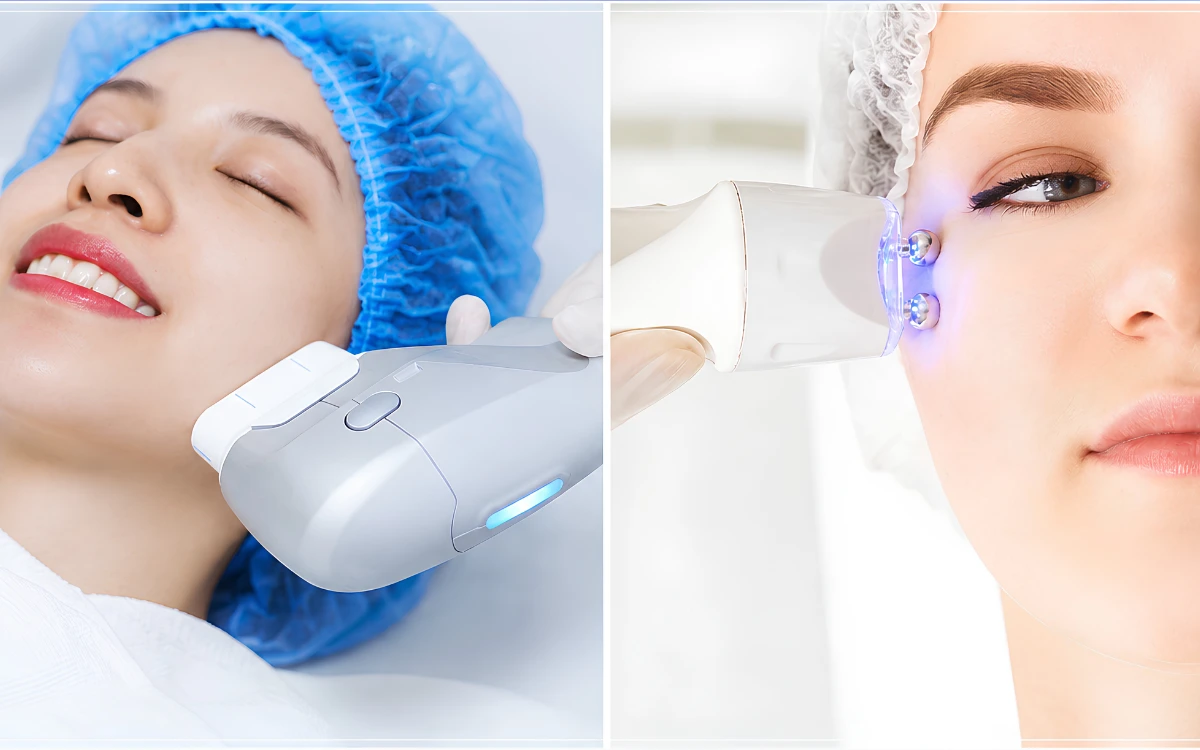
Loose skin, a softer jawline, fine lines, and reduced facial definition are common changes that develop as collagen and elastin gradually decline.
For patients who are not ready for surgery, energy-based treatments may offer a way to improve mild to moderate skin laxity with little or no significant downtime. Two of the most widely discussed options are radiofrequency skin tightening and ultrasound skin tightening.
Although both treatments use controlled energy to stimulate collagen, they are not the same. They deliver different forms of energy, may target different tissue depths, and can be selected for different skin concerns.
This is why the question of HIFU vs RF cannot be answered simply by saying that one technology is better. The right treatment depends on the patient’s skin quality, facial anatomy, degree of laxity, treatment area, device being used, and expected result.
For anyone considering RF Skin Tightening Dubai or Ultrasound Skin Tightening Dubai, this guide explains the differences, potential benefits, limitations, recovery, and how a medical professional may choose between the two.
Why Does the Skin Become Loose?
Skin firmness depends on several structures working together.
Collagen provides strength and support, while elastin allows the skin to stretch and return to its original position. Facial fat, retaining ligaments, muscles, and underlying bone also contribute to facial shape.
As ageing progresses:
- Collagen production slows down.
- Existing collagen becomes less organised.
- Skin elasticity decreases.
- Facial fat may shift or lose volume.
- Deeper tissues may descend.
- The jawline can become less defined.
- Fine lines may become more noticeable.
- Mild sagging may develop around the cheeks and neck.
Sun exposure, smoking, weight fluctuations, stress, genetics, and general health can influence how quickly these changes appear.
Non-surgical energy treatments mainly work by heating selected tissues to stimulate a healing and remodelling response. They may improve skin firmness, but they do not remove excess skin or reposition tissues in the same way as surgery.
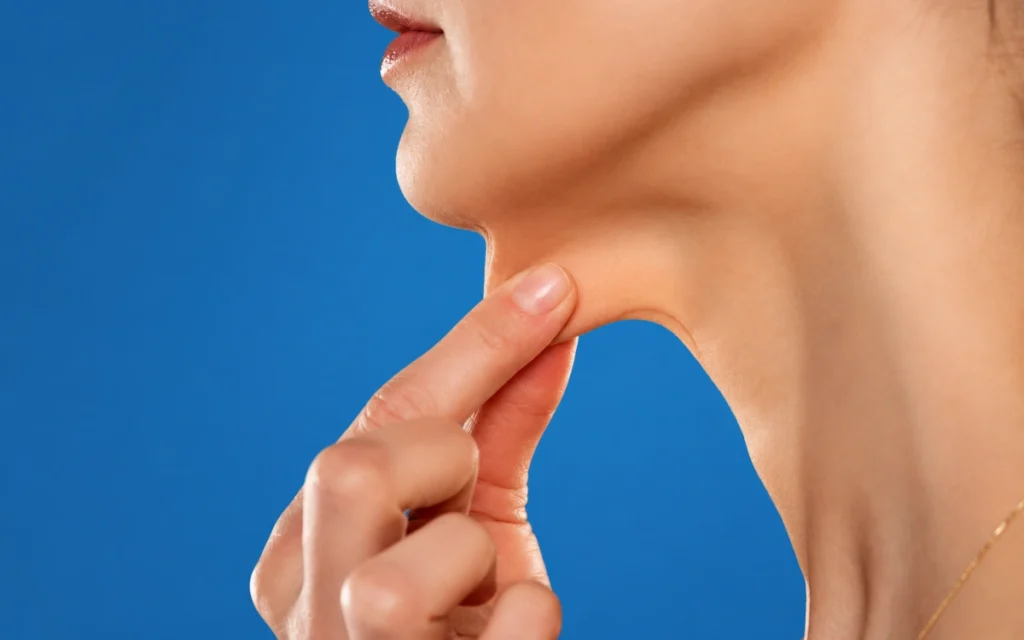
What Is RF Skin Tightening?
RF stands for radiofrequency.
Radiofrequency devices use electromagnetic energy to generate controlled heat within the skin and, depending on the device, the tissues beneath it.
The heat can cause an immediate contraction of some collagen fibres and stimulate a longer-term repair response. Over the following weeks and months, the body may produce and reorganise collagen and elastin.
RF Skin Tightening Dubai may be used to improve concerns such as:
- Mild skin laxity
- Fine lines
- Reduced skin firmness
- Crepey skin
- Softening of the jawline
- Mild neck laxity
- Certain textural concerns
However, “RF treatment” is a broad term. Several different types of radiofrequency technology exist, and they do not all work in the same way.
Types of RF Skin Tightening
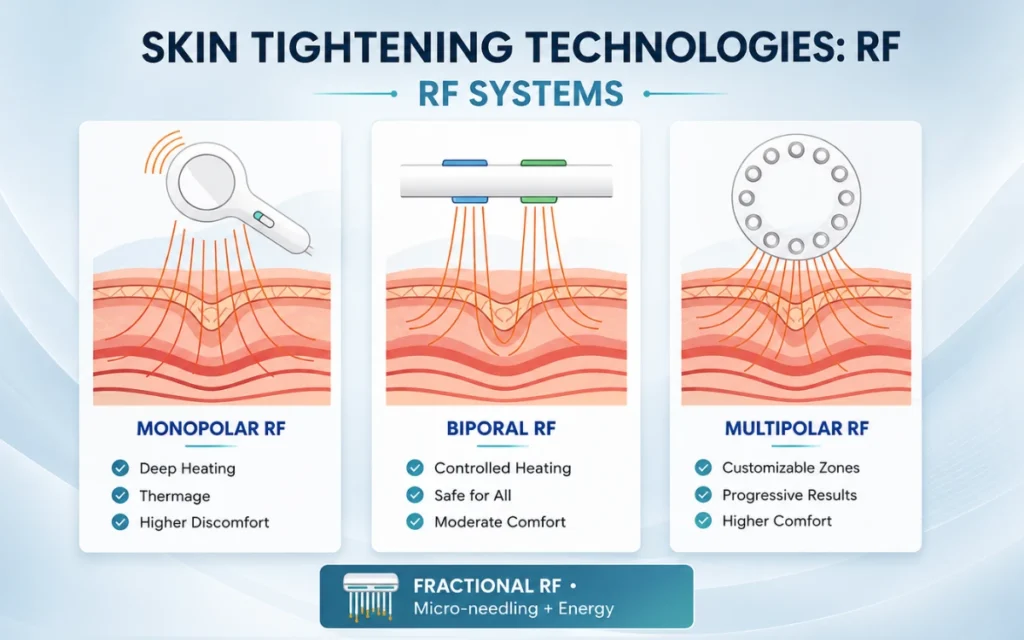
Understanding the different forms of RF is important when comparing treatment options.
Monopolar RF
Monopolar radiofrequency passes energy between a treatment tip and a grounding pad placed elsewhere on the body.
It can create relatively broad and deep heating, depending on the device and settings.
Monopolar RF is commonly used for non-invasive facial and body tightening.
Bipolar RF
Bipolar radiofrequency passes energy between two electrodes located within the treatment handpiece.
The energy generally travels through a more controlled area between the electrodes.
It is often used for skin tightening, texture, and facial rejuvenation.
Multipolar RF
Multipolar devices use several electrodes to deliver heat through different pathways.
They may provide more even heating across a treatment area.
RF Microneedling
RF microneedling combines needles with radiofrequency energy.
The needles enter the skin and deliver energy at selected depths. This may help address:
- Skin laxity
- Acne scars
- Fine lines
- Enlarged pores
- Uneven texture
RF microneedling is different from non-invasive surface RF because it breaks the skin barrier and may involve more downtime and additional risks.
When a clinic recommends RF Skin Tightening Dubai, patients should ask which type of RF is being offered. Results, discomfort, recovery, and risks vary between technologies.
What Is Ultrasound Skin Tightening?
Ultrasound skin tightening uses focused sound-wave energy to create controlled thermal points beneath the skin.
The most recognised form is High-Intensity Focused Ultrasound, commonly called HIFU. Some devices use microfocused ultrasound, with or without real-time visualisation.
Unlike RF, which may create broader zones of heating, focused ultrasound delivers energy to precise points at selected depths.
Depending on the device and treatment cartridge, ultrasound energy may target:
- The deeper dermis
- Subcutaneous tissue
- Deeper supportive tissue layers
The controlled heat stimulates collagen contraction and gradual remodelling.
Ultrasound Skin Tightening Dubai is frequently used for:
- Mild to moderate facial laxity
- Early jowls
- Reduced jawline definition
- Mild neck laxity
- Brow-area lifting in selected patients
- Submental or under-chin laxity
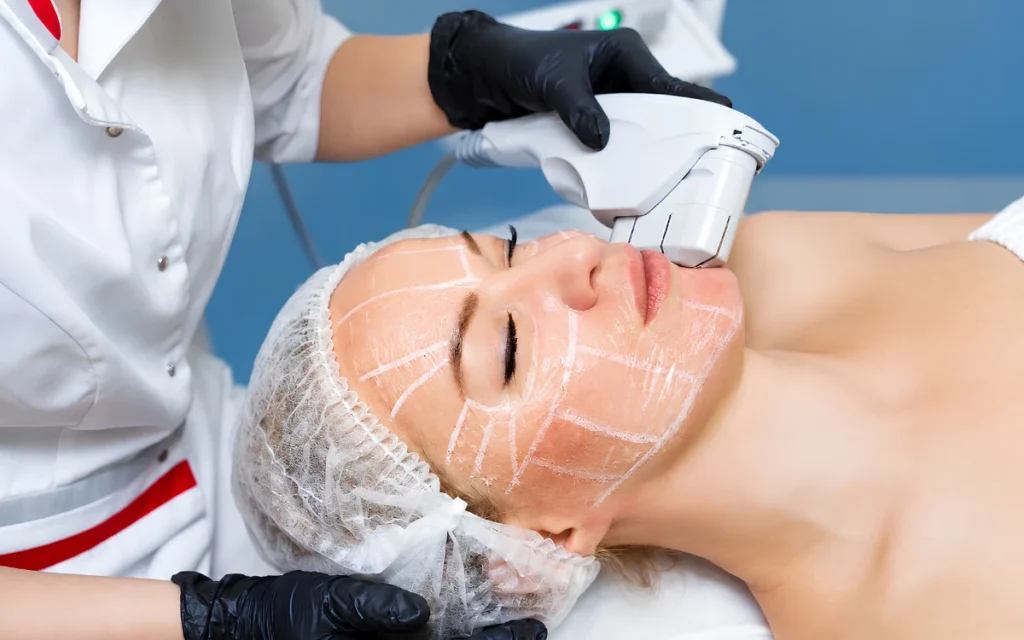
HIFU vs RF: The Main Difference
The main difference is the type of energy used and the pattern in which that energy is delivered.
RF Skin Tightening
RF uses electromagnetic energy to heat tissue.
Depending on the device, it may create broader, more diffuse heating across the dermis and subcutaneous layers.
Ultrasound Skin Tightening
HIFU or focused ultrasound uses sound-wave energy.
It creates small, focused thermal points at specific depths beneath the skin.
In simple terms, RF often heats a wider area, while focused ultrasound creates more concentrated treatment points within selected tissue layers.
This does not automatically mean ultrasound is stronger or RF is gentler. Treatment depth and intensity vary considerably between devices, settings, and techniques.
Which Treatment Works More Deeply?
This is one of the most common questions in the HIFU vs RF discussion.
Ultrasound devices are often selected when the aim is to target deeper supportive layers in a precise pattern. Some HIFU systems can deliver treatment at multiple depths.
Certain RF devices can also deliver energy into deeper tissues. Monopolar RF may generate deeper, broad heating, while RF microneedling can place energy at specific depths through needles.
Therefore, it is not accurate to say that all HIFU devices work deeply and all RF devices work superficially.
The actual depth depends on:
- The treatment device
- Handpiece or cartridge
- Needle depth, when applicable
- Energy settings
- Treatment area
- Skin and tissue thickness
- Operator technique
Patients should discuss the specific technology being recommended rather than choosing treatment based on the terms “RF” or “HIFU” alone.
What Does RF Skin Tightening Treat Best?
RF may be considered when the primary concern is general skin firmness, texture, or mild laxity.
Depending on the technology, it may be suitable for:
- Mildly loose skin
- Fine lines
- Crepey texture
- Early ageing changes
- Mild laxity on the face or neck
- Skin that would benefit from gradual collagen stimulation
- Acne scarring when RF microneedling is used
RF treatments may also be used on certain body areas, although device indications and outcomes vary.
Patients seeking Non-Surgical Skin Tightening Dubai may prefer RF when they want gradual improvement across a broader treatment area.
What Does Ultrasound Skin Tightening Treat Best?
Focused ultrasound is often considered when the main concern is mild tissue laxity or reduced facial definition.
It may be used for:
- Early jowls
- Mild jawline softening
- Slight neck laxity
- Mild drooping around the lower face
- Under-chin laxity
- Brow heaviness in carefully selected cases
Ultrasound treatment is commonly chosen when deeper, focused collagen stimulation is desired.
However, it should not be expected to create the same lift as surgical facial repositioning.
Which Treatment Is Better for Fine Lines?
RF may sometimes be preferred when fine lines and overall skin quality are the main concerns, particularly when a treatment is designed to heat the dermis more evenly.
RF microneedling may provide additional improvement for fine lines and texture because it combines controlled needling with thermal stimulation.
Focused ultrasound is generally selected more for laxity and contour than for superficial fine lines, although improved collagen may produce some secondary improvement in skin quality.
If wrinkles are mainly caused by muscle movement, neither treatment may be the most appropriate first choice. Neuromodulator injections may be considered instead.
If lines are related to pigmentation, dryness, or surface damage, skin resurfacing or medical skin care may be more suitable.
Which Treatment Is Better for the Jawline?
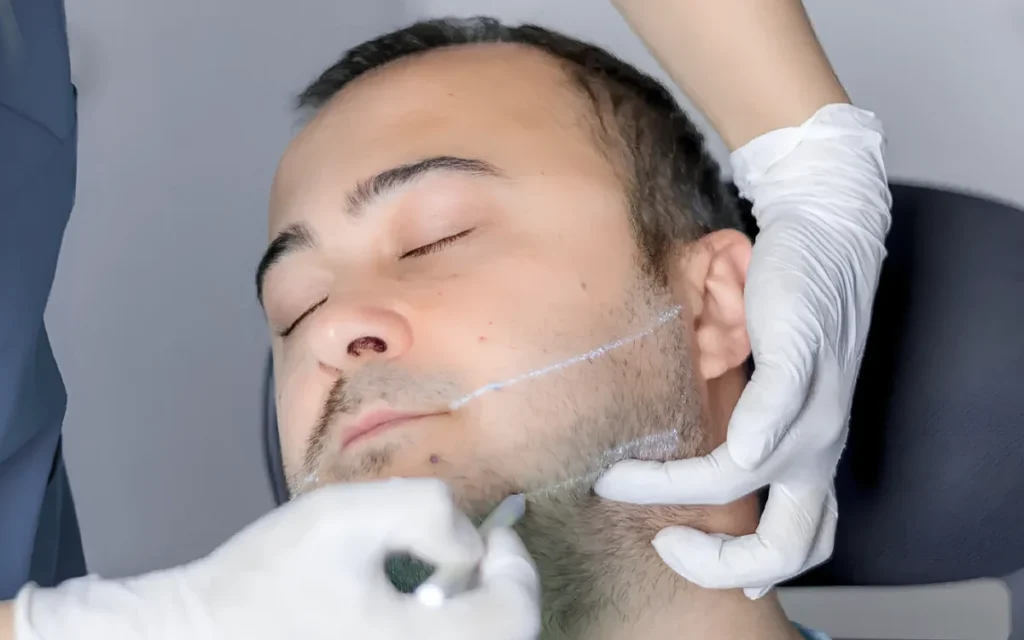
Both RF and ultrasound may help improve mild jawline softness.
Focused ultrasound is often selected when the aim is to stimulate deeper support around the lower face and under-chin area.
RF may help improve overall skin firmness along the jawline and neck, particularly when laxity is mild.
The better option depends on what is causing the reduced definition.
For example:
- Loose skin may respond to tightening treatment.
- Excess fat may require a different approach.
- A small or recessed chin may need structural enhancement.
- Significant jowls may require surgical repositioning.
- Volume loss may require carefully planned restoration.
A soft jawline is not always simply a skin problem.
Which Treatment Is Better for Skin Texture?
RF, especially RF microneedling, is more commonly used when texture is an important concern.
It may be considered for:
- Acne scars
- Enlarged pores
- Fine lines
- Uneven surface texture
- Mild crepiness
HIFU is not primarily a skin-resurfacing treatment. It works beneath the surface and is generally less focused on pores, acne scarring, and superficial irregularities.
Patients with both laxity and texture concerns may benefit from a combination plan rather than relying on one device.
Does Either Treatment Reduce Facial Fat?
Some energy-based treatments can affect subcutaneous tissue, depending on the technology, treatment depth, settings, and area treated.
This can sometimes be useful when carefully planned for areas with unwanted fullness. However, unintended fat loss can be undesirable, especially in thinner faces or areas where volume is already limited.
Excessive or inappropriate energy delivery may lead to facial hollowing or contour irregularities.
Patients with:
- Naturally slim faces
- Hollow cheeks or temples
- Significant age-related volume loss
- Very thin skin
- Previous fat-reducing treatments
may require a particularly conservative approach.
The goal should be to tighten the correct tissue without unnecessarily reducing supportive facial volume.
How Quickly Will You See Results?
Neither treatment usually produces its complete result immediately.
Some patients notice temporary firmness soon after treatment because of tissue contraction or mild swelling. However, collagen remodelling develops gradually.
RF Results
Improvement may become more noticeable over several weeks or months.
Some RF protocols involve a course of treatments, while certain higher-energy devices may be used less frequently.
Ultrasound Results
HIFU results generally develop gradually over two to three months and may continue evolving as collagen remodels.
The timeline varies according to the device, treatment intensity, individual healing response, and severity of laxity.
How Many Sessions Are Needed?
There is no universal number.
RF Treatment Plans
Some non-invasive RF devices are used as a series of sessions. Other platforms may be designed as a single treatment followed by maintenance.
RF microneedling is commonly performed as a course, with the number of sessions based on texture, scarring, laxity, and skin response.
Ultrasound Treatment Plans
Some patients undergo one focused ultrasound session and then review the result after collagen remodelling.
Additional or maintenance sessions may be considered, but repeated treatment should not be performed unnecessarily.
A provider should not recommend a fixed package without first assessing the patient’s anatomy, skin thickness, and treatment goals.
Which Treatment Is More Comfortable?
Comfort varies significantly between individuals and devices.
RF Sensation
Non-invasive RF is commonly described as a deep warming sensation. Cooling systems and real-time temperature monitoring may improve comfort.
RF microneedling may require topical anaesthetic because needles enter the skin and deliver energy internally.
Ultrasound Sensation
HIFU may cause brief, sharp, tingling, or deep aching sensations as energy is delivered. Certain areas, particularly around the jawbone, may feel more sensitive.
Discomfort does not reliably indicate whether a treatment is working. Excessive pain should always be communicated to the practitioner.
Downtime After RF Skin Tightening
Downtime depends on the type of RF treatment.
After non-invasive RF, patients may experience:
- Mild redness
- Temporary warmth
- Slight swelling
- Tenderness
These effects often settle quickly.
RF microneedling may cause:
- More noticeable redness
- Swelling
- Pinpoint marks
- Dryness
- Temporary sensitivity
- Short-term roughness or crusting
Because RF microneedling breaks the skin surface, aftercare and infection prevention are especially important.
Downtime After Ultrasound Skin Tightening
Most patients experience little visible downtime after ultrasound treatment.
Temporary effects may include:
- Redness
- Mild swelling
- Tenderness
- Tingling
- Temporary numbness
- A bruised or aching sensation
Some sensations may last longer than the visible redness.
Patients should be given clear instructions about expected effects and when to contact the clinic.
Possible Risks of RF Treatment
Potential risks depend on the specific RF technology.
They may include:
- Redness
- Swelling
- Bruising
- Burns
- Blistering
- Pigment changes
- Infection
- Scarring
- Fat loss
- Contour irregularity
- Nerve injury
- Prolonged tenderness
RF microneedling requires particular caution because needles and thermal energy are delivered into the skin.
Appropriate device selection, sterile technique, correct settings, and detailed anatomical knowledge are essential.
Possible Risks of Ultrasound Treatment
Potential risks may include:
- Redness
- Swelling
- Tenderness
- Bruising
- Temporary numbness
- Tingling
- Burns
- Welts
- Fat loss
- Uneven contours
- Temporary muscle weakness
- Nerve irritation or injury
Accurate placement is especially important around facial nerves, blood vessels, thin tissue, and bony areas.
Some ultrasound platforms provide visualisation of tissue layers, which may help the practitioner confirm treatment depth before delivering energy.
Who May Be Suitable for RF?
RF may be considered for patients who:
- Have mild skin laxity
- Want gradual tightening
- Are concerned about fine lines or skin quality
- Have early crepey texture
- Prefer a non-surgical option
- Understand that more than one session may be needed
RF microneedling may be considered when texture, acne scars, and laxity are present together.
Who May Be Suitable for Ultrasound?
Ultrasound may be considered for patients who:
- Have mild to moderate laxity
- Want improved jawline or neck definition
- Have early jowling
- Prefer treatment without incisions
- Have realistic expectations about the degree of lift
- Are not yet ready for surgery
Neither option is determined by age alone.
Who May Not Be Suitable?
Treatment may need to be avoided, delayed, or modified for patients with certain conditions.
These may include:
- Active infection
- Open wounds
- Severe inflammatory skin disease
- Certain implanted electrical or metal devices
- Pregnancy
- Significant bleeding disorders
- Certain neurological conditions
- Recent facial procedures
- Severe skin laxity requiring surgery
- Unrealistic expectations
Suitability varies between devices. Medical history, medications, previous fillers, threads, implants, and surgery should be disclosed before treatment.
Can RF and HIFU Be Combined?
Yes, selected patients may benefit from both because the technologies can target tissue in different patterns.
For example:
- HIFU may be used for deeper, focused tightening.
- RF may be used for broader dermal heating and skin quality.
- RF microneedling may address texture and mild laxity.
However, combining treatments does not automatically create a better result.
Incorrect sequencing, excessive energy, or treating the same area too aggressively may increase the risk of inflammation, fat loss, or tissue injury.
A combination plan should include clear reasons for each treatment and sufficient recovery time where required.
Can These Treatments Replace a Facelift?
No.
The term Non-Surgical Skin Tightening Dubai can sometimes create the impression that energy treatments offer results equivalent to surgery.
A surgical facelift can:
- Reposition descended facial tissues
- Address more advanced jowls
- Remove excess skin
- Improve significant neck laxity
- Create a more substantial and predictable lift
RF and ultrasound stimulate collagen but do not remove excess skin or surgically reposition deeper structures.
They tend to work best for mild to moderate concerns.
Patients with advanced facial ageing may be disappointed if a non-surgical device is presented as a replacement for facelift surgery.
RF vs Ultrasound Skin Tightening: Comparison
| Feature | RF Skin Tightening | Ultrasound Skin Tightening |
| Energy used | Radiofrequency electromagnetic energy | Focused sound-wave energy |
| Heating pattern | Often broader or more diffuse | Precise thermal points |
| Typical focus | Firmness, fine lines and texture | Laxity, contour and deeper support |
| Treatment depth | Varies by RF device | Selected depths based on cartridge or device |
| Skin penetration | Non-invasive or needle-assisted | Usually non-invasive |
| Sessions | May require a course | Often performed as one session before review |
| Downtime | Minimal for surface RF; greater with RF microneedling | Usually minimal |
| Results | Gradual | Gradual |
| Best suited for | Mild laxity and skin-quality concerns | Mild to moderate laxity and contour concerns |
| Surgical replacement | No | No |
This comparison is general. Individual devices may behave differently.
How to Choose Between HIFU and RF
The choice should begin with the concern, not the device.
A practitioner should assess:
- Skin thickness
- Degree of laxity
- Facial volume
- Fat distribution
- Bone structure
- Treatment area
- Previous procedures
- Skin tone
- Tendency towards scarring or pigmentation
- Desired result
- Willingness to accept downtime
RF may be more suitable when general firmness, fine lines, texture, or acne scarring are important.
Ultrasound may be more suitable when mild lower-face, jawline, or neck laxity is the main concern.
Some patients may benefit from neither. Skin care, injectables, resurfacing, fat management, or surgery may better address the actual problem.
Choosing a Skin-Tightening Provider in Dubai
The device alone does not determine the quality of the outcome.
When considering RF Skin Tightening Dubai or Ultrasound Skin Tightening Dubai, ask:
- What is the exact device being used?
- Is the device authorised for the proposed treatment?
- Who will perform the procedure?
- What training does the practitioner have?
- Which tissue depth will be treated?
- Why is this technology suitable for my face?
- Could treatment reduce facial fat?
- What results are realistic?
- How many sessions are genuinely needed?
- What complications has the provider managed?
- What should I do if I experience a problem?
Treatment should take place in an appropriately licensed medical setting with proper consultation, documentation, consent, and follow-up.
Final Thoughts
The central difference in HIFU vs RF is how energy is delivered to the tissues.
Radiofrequency uses electromagnetic energy to create controlled heating. Depending on the device, this heating may be broad, deep, superficial, non-invasive, or delivered through microneedles.
Focused ultrasound uses sound-wave energy to create precise thermal points at selected depths beneath the skin.
For patients seeking Non-Surgical Skin Tightening Dubai, RF may be helpful for general firmness, fine lines, crepey texture, and mild laxity. Ultrasound may be preferred for focused treatment of mild to moderate laxity around the jawline, lower face, and neck.
Neither treatment is automatically superior, and neither can reproduce the results of facelift surgery.
Frequently Asked Questions
Is HIFU better than RF?
Not universally. HIFU may be preferred for focused treatment of deeper laxity, while RF may be selected for broader tightening, fine lines, or texture. The correct choice depends on the patient and the device.
Which treatment gives a stronger lift?
Focused ultrasound may produce a more noticeable lifting effect in selected patients with mild to moderate laxity. However, outcomes vary, and neither treatment produces the same lift as surgery.
Is RF better for wrinkles?
RF may help improve fine lines and skin quality. RF microneedling may also address texture and acne scars. Wrinkles caused mainly by muscle movement may need a different treatment.
Can RF and HIFU cause facial fat loss?
They can affect deeper tissues depending on device settings, depth, and technique. Unwanted fat loss is a potential risk, particularly in lean faces or when treatment is overly aggressive.
How long do the results last?
Results vary according to age, skin condition, device, lifestyle, treatment settings, and natural ageing. Maintenance may be recommended, but repeated sessions should be individually planned.
Which option has less downtime?
Non-invasive RF and HIFU generally involve minimal visible downtime. RF microneedling usually causes more redness and short-term skin recovery.
Can I undergo treatment after fillers?
Possibly, but timing and treatment depth matter. The provider should know the location, type, and date of all previous fillers and other procedures before recommending energy treatment.